work / full-stack / polaris
Polaris
An AI academic strategist that reverse-engineers competitive university-admission profiles, with structured-output LLM tool use and transparent probability modeling.
- llm mode
- structured
- typed JSON via responseSchema
- knowledge base
- 60 docs
- cosine search, no vector DB
- probability
- transparent
- top-3 weighted factors
- offline
- full demo
- heuristic fallback, no key
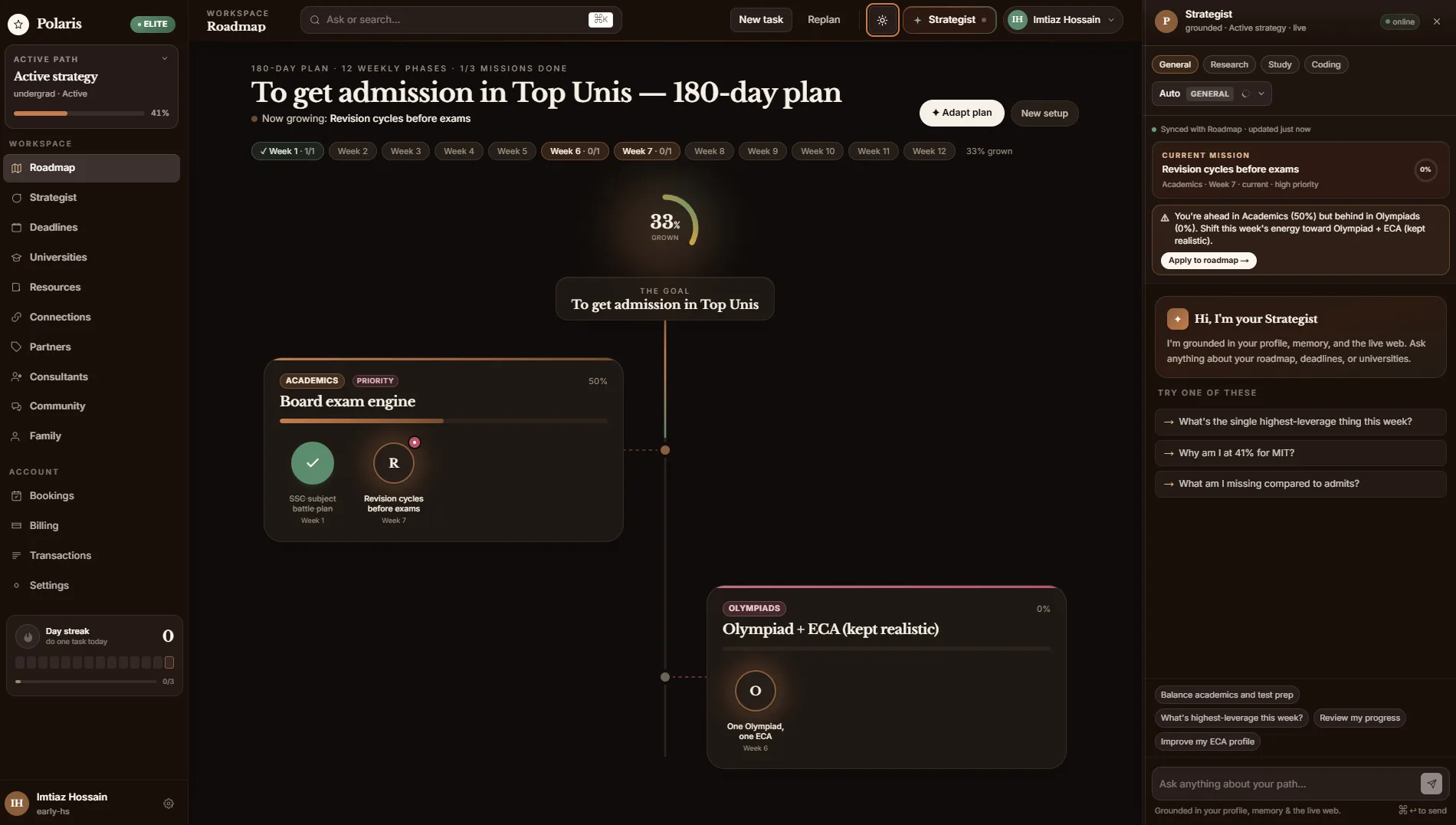
system architecture / interactive
The problem
Competitive university admissions are gatekept by fragmented Reddit threads and $2,000+ consultants. Polaris replaces both with a transparent, data-driven roadmap, an AI-native platform that reverse-engineers what successful applicants actually did, from early schooling through graduate school. It was my submission to the Infinity AI BuildFest 2026.
Structured-output LLM, not a chatbot wrapper
The core engineering decision is that Polaris does not wrap a chat model. Gemini 2.0 Flash
returns typed JSON conforming to a responseSchema, so /api/roadmap yields 8-12
milestones grouped by quarter, each with a rationale grounded in real knowledge-base
documents. Because the output is structurally guaranteed, the dashboard can render it
confidently instead of parsing free text.
Retrieval is deliberately infrastructure-free: roughly 60 curated documents (universities,
scholarships, accepted-student case studies) at 768 dimensions live in a single
embeddings.json, and cosine search runs in pure TypeScript. No vector database. Adding a
country is adding a JSON document and re-running the embeddings script, so the architecture
scales globally without code changes.
Transparent probability, by design
The acceptance-probability engine is a logistic-regression model with visible factor weights. Every prediction shows its top-three contributing factors and their magnitudes, and users can simulate "what if I add X" with live sliders. Crucially, it uses no demographic proxies, ethical AI by construction rather than as a disclaimer.
Graceful degradation
A demo that only works with a paid API key is a fragile demo. Without a Gemini key, Polaris transparently falls back to keyword-overlap retrieval and a deterministic heuristic roadmap engine, so the entire vertical slice (landing, intake, strategist, dashboard, probability simulator) is verifiable offline. Paid CTAs degrade to the working free tier when LemonSqueezy is unconfigured.
Production hardening
Polaris is account-based with role-aware access (student, parent, partner, admin) and server-plus-client feature gating across Free / Pro / Elite tiers. Parents and partners get a read-only monitoring dashboard via token-based linking. The stack is hardened with Zod validation, centralized API error handling, MongoDB indexes, environment validation, and security headers. Payments run through LemonSqueezy as a merchant of record, which matters for Bangladesh-based payouts, with signed webhooks flipping the user's plan.
walkthrough / watch it in action
stack
the evidence