work / games / opengl-games
OpenGL Games Trilogy
Three games built on raw OpenGL primitives for CSE423, where every raindrop, diamond, and laser bolt is drawn from points and lines by hand.
period
2026
status
coursework
- games
- 3
- one per lab assignment
- rendering
- primitives
- GL_POINTS / GL_LINES
- line drawing
- midpoint
- 8-zone algorithm
- engine
- none
- raw game loops
The constraint is the point
CSE423 (Computer Graphics) bans the shortcuts: no sprites, no textures, no engine. Everything on screen must be constructed from OpenGL primitives, points and lines placed by algorithms you wrote yourself. Under that constraint, even a raindrop becomes an exercise in computational geometry. These three games were built with PyOpenGL and GLUT.
House in Rainfall
An environment simulation: a house in a rainstorm where rainfall direction responds to wind controls (arrow keys bend the rain progressively left or right) and the scene transitions smoothly between day and night. Hundreds of raindrops are line segments whose positions update each frame, respawning at the top with randomized offsets, and the day-night cycle interpolates the palette continuously rather than snapping.
Catch the Diamonds
A falling-object arcade game: diamonds spawn at random positions and fall at increasing speed; the player slides a catcher bar with the keyboard. The interesting parts are drawn and detected by hand: the diamond is composed with the midpoint line algorithm across all eight zones (the classic incremental technique that generalizes line drawing to any slope), and catching uses AABB collision between the diamond and the catcher. Miss once and the game ends, with score persistence across the session, plus pause/restart/exit buttons drawn from primitives too.
Star Wars
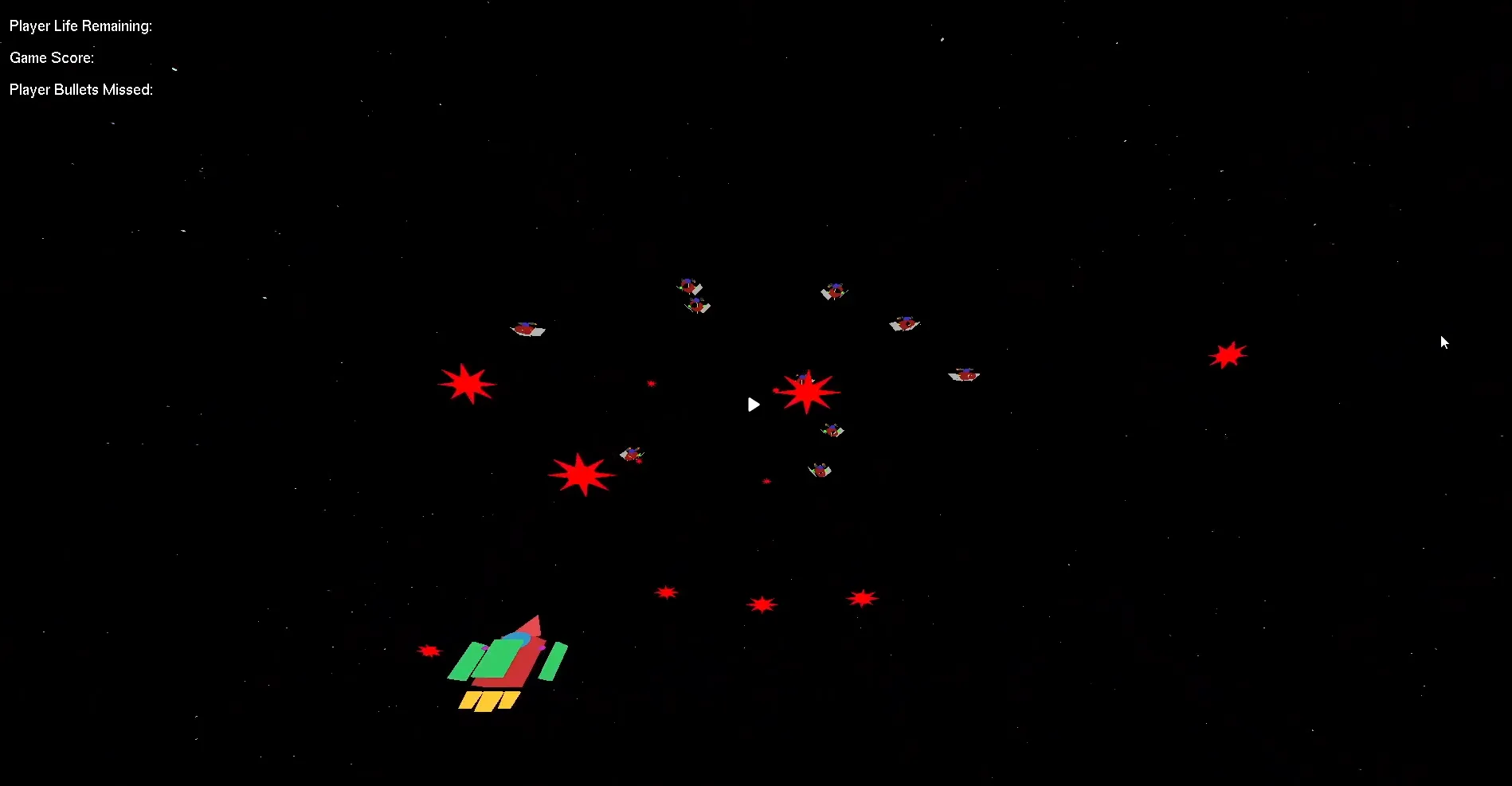
A shooter where the player ship fires at descending enemies, with movement, projectile pooling, hit detection, lives, and score, all running in a hand-rolled GLUT game loop with keyboard state tracking for smooth simultaneous move-and-shoot input.
What carried over
Writing the render loop, input handling, spawning, and collision from scratch (the parts an engine normally hides) is exactly what made later graphics work legible to me. When you have implemented the midpoint algorithm yourself, a rasterizer stops being magic.
stack
the evidence